
How to Stop Reacting Impulsively Under Pressure and Respond the Way You Intend

Emotional Reset Insights . 6 min read . Emotional regulation coaching
Why Do Good Intentions Still Turn Into Impulsive Reactions?
Most people don't intend to react impulsively. They plan to stay calm, listen well, and handle difficult conversations with wisdom. Yet when emotions intensify, many find themselves saying or doing the very thing they hoped to avoid.
Learning how to stop reacting impulsively isn't about suppressing emotions. It's about learning to pause within the space between feelings and what happens next so you have the opportunity to choose a response that aligns with your intentions instead of moving into an automatic learned reaction.
Why We React Impulsively Under Pressure
When pressure results in emotional intensity, familiar learned reactions come to the surface. Over time, we experienced criticism, rejection, disappointment, conflict, being misunderstood, embarrassment, and other moments that affected how we reacted.
When pressure results in emotional intensity, learned reactions come to the surface.
Why Willpower Usually Isn't Enough
Many people assume they simply need more discipline or self-control. But knowing how you want to respond does not necessarily mean you will respond that way when emotions intensify.
By the time many people realize they are reacting, the reaction is already underway. The challenge is not simply a lack of knowledge. When emotions intensify, a familiar learned reaction can come to the surface before we pause within the space of opportunity.
Using the Space of Opportunity
Emotional Reset approaches these moments differently. The space of opportunity already exists between feelings and what happens next.
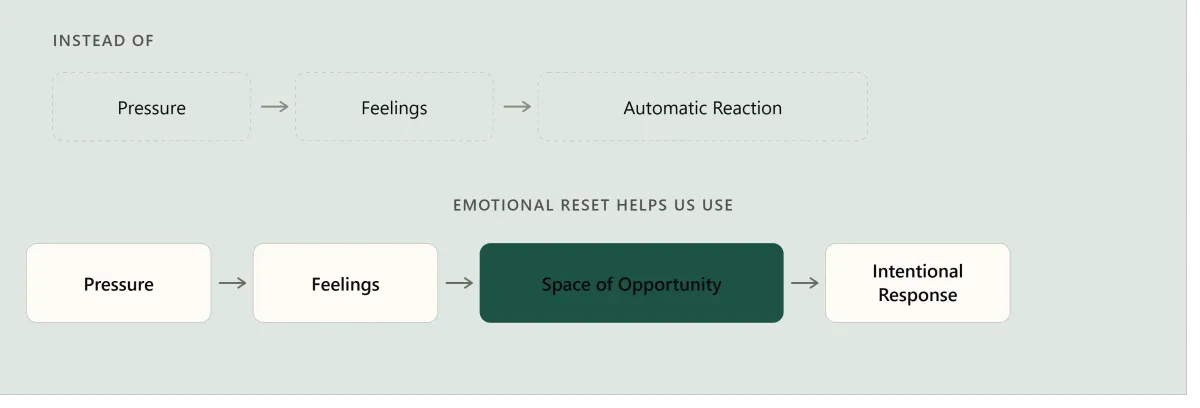
Pausing within that space gives us the opportunity to choose what happens next:
Within that space, we can move into a learned reaction, or we can pause and choose a response that aligns more closely with our intentions.
Why Knowing You Should Pause Isn't Enough
You may already know that you should pause before responding, think before you speak, or give yourself time to make a different choice. The difficulty is rarely knowing that those things would help.
The difficulty is pausing within that space when emotions intensify and an automatic learned reaction is already coming to the surface
This is why simply telling yourself to “stop reacting” often doesn't create lasting change. The issue isn't a lack of intention. It's what happens between feelings and what happens next.
Emotional Reset focuses on learning to use that space. Rather than asking you to ignore what you feel or simply control your reaction, the process helps you pause within the space of opportunity and choose how you want to respond when a familiar learned reaction comes to the surface.
Reflection
Where do you notice a difference between how you intend to respond and how you actually react when emotions intensify?
The Emotional Reset perspective
Most people already know how they want to respond. The difficulty is that automatic learned reactions often take over before conscious intention has an opportunity to lead. Emotional Reset helps us learn to pause within the space of opportunity between feelings and what happens next, giving us the opportunity to choose a response that more closely aligns with our intentions.
Frequently asked questions
Why do I react impulsively even when I know better?
Automatic learned reactions often move faster than conscious intention.
Can emotions be helpful?
Yes. Emotions provide valuable information, but they do not have to determine your response.
Is reacting the same as responding?
No. Reactions are automatic; responses are intentional choices.
Can impulsive reactions be changed?
Yes. People can learn to pause within the space of opportunity and choose responses that more closely align with their intentions.
Ready to move beyond awareness?
Learn How to Use the Space Between What You Feel and What Happens Next.
Emotional Reset helps high performers learn to pause within the space between what they feel and what happens next, even in the moments that matter most.
© 2026 Alessandra Group - LLC emotionalresetgroup.com