
How to Improve Decision Making Under Pressure Without Letting Emotions Choose for You
Good decisions don't usually disappear under pressure our responses do.
Emotional Reset Insights . 8 min read . Decision making under pressure
Everyone has experienced the moment. A difficult conversation begins. An unexpected email arrives. A client challenges your work. A family member says something that lands the wrong way. Within seconds, your emotions intensify, your thoughts speed up, and the response that comes out isn't the one you intended.
Later, you replay the moment and think:
"Why did I say that? That's not how I wanted to handle it."
Many people assume they have a decision-making problem. In reality, they often have a response problem.
Improving decision making under pressure isn't about becoming emotionless. It's about learning how to create enough space between what you feel and how you respond so your decisions reflect your intentions instead of your automatic reactions.
Why pressure makes decision making so difficult
Pressure changes the conditions under which we make decisions.
When emotions intensify, our attention narrows. We become more focused on relieving immediate discomfort than making choices that align with our long-term goals. The desire to defend ourselves, avoid conflict, prove a point, or escape discomfort can quietly take over.
This is why people often:
Speak before thinking.
Withdraw from important conversations.
Become defensive when receiving feedback.
Say "yes" when they really want to say "no."
Make impulsive decisions they later regret.
The challenge isn't that you've suddenly become someone different. Pressure doesn't change who you are. It intensifies emotions and brings familiar learned reactions to the surface.
That's an important distinction, because that reaction is not your identity. It is a familiar learned reaction that surfaced in that moment.
Why better decision making isn't just about thinking harder
A common misconception is that better decisions come from more analysis.
While thoughtful analysis certainly matters, many decisions made under pressure aren't limited by a lack of intelligence or information. They're limited by timing.
By the time many people realize they're reacting emotionally, the reaction is already unfolding.
This is why advice like "just stay calm," "think before you speak," or "don't let your emotions control you" often feels frustrating.
Most people already know how they want to respond. The difficulty is making that choice when emotions intensify.
The issue isn't simply a lack of knowledge. It's what happens when emotions intensify and a familiar learned reaction begins to surface.
How Emotional Reset approaches decision making differently
The Emotional Reset process helps people recognize when automatic reactions begin to surface and intentionally create a pause before responding.
Emotional Reset approaches decision making under pressure differently. Rather than asking you to suppress emotions, it recognizes that emotions are real and meaningful. The goal is not to eliminate them but to prevent them from making your decisions for you.
That pause changes everything. Instead of moving directly from pressure to reaction, the sequence becomes:
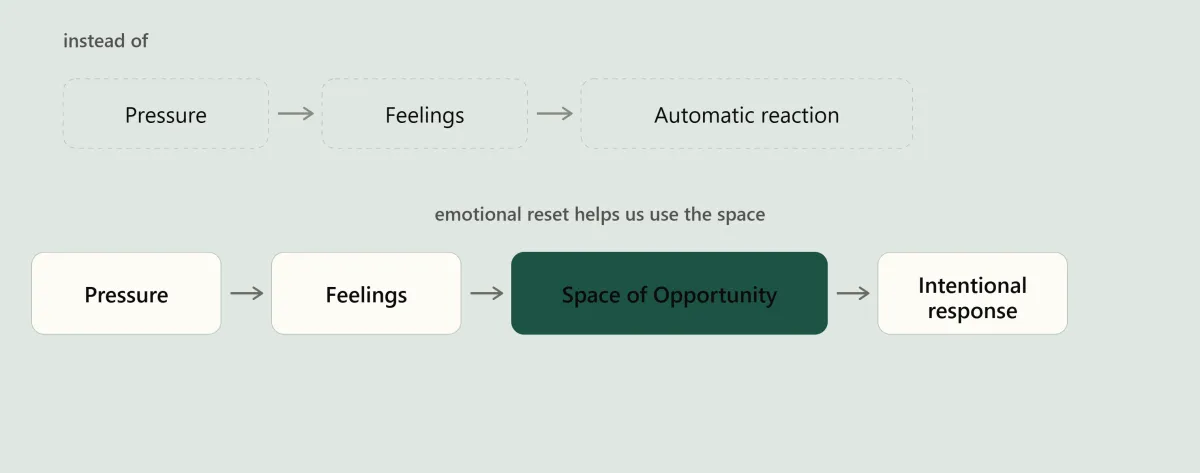
That moment of space allows you to ask:
What response aligns with who I want to be?
What outcome am I actually trying to create?
Will this response move me toward or away from that outcome?
Am I responding intentionally, or am I simply reacting?
Most people already know they would benefit from slowing down, thinking before speaking, or making a different choice. The challenge is being able to make that intentional choice before a familiar learned reaction takes over. That is the work Emotional Reset is designed to address.
Reflection
Where in your life do automatic reactions most often create decisions
you don't want?
The Emotional Reset Perspective
Many people believe they need more discipline, greater willpower, or better emotional control to make better decisions under pressure.
But often, they already know exactly how they want to respond. The challenge is that when emotions intensify, automatic learned reactions can move faster than conscious intention.
Emotional Reset addresses the gap between intention and reaction by helping create space for a chosen response when emotions intensify.
Frequently asked questions
Why is decision making under pressure so difficult?
Pressure intensifies emotions, making automatic learned reactions more likely to surface.
Can emotions improve decision making?
Yes. Emotions provide valuable information, but they should not be the sole driver of behavior.
Is decision making under pressure the same as emotional intelligence?
No. Emotional intelligence is broader; decision making under pressure focuses on how emotions influence choices.
How can I stop making impulsive decisions?
Impulsive decisions can occur when emotions intensify and familiar learned reactions surface before there is space for an intentional response.


Ready to Respond Under Pressure the Way You Actually Intend To?
Emotional Reset coaching helps you build the space between emotion and reaction so executive presence, nervous system regulation, and decision making under pressure finally align with how you actually want to respond. Ready to stop reacting and start responding with intention?
Related Articles
Why Emotional Regulation Coaching Isn’t
High performers rarely struggle because they lack awareness. They know when they're frustrated. They recognize when..
Nona Giddens
Nona Giddens
How to Stop Reacting Impulsively Under...
Most people don't intend to react impulsively. They plan to stay calm, listen well, and handle difficult conversations with..
Nona Giddens
Nona Giddens
Why nervous system regulation alone doesn't
You recognize the tightness in your chest. You notice your breathing change. You know your body is responding to .....
Nona Giddens
Nona Giddens
© 2026 Alessandra Group - LLC emotionalresetgroup.com