
Executive presence begins with how you respond under pressure
Your presence is felt most clearly the moment the pressure rises.
Emotional Reset Insights 6 min read Executive presence coaching
A difficult question lands in the middle of a high-stakes meeting. A colleague challenges your recommendation. A client pushes back harder than expected. In seconds, the conversation changes and so can the way you respond.
For many professionals, executive presence is tested most clearly in moments like these. Not because pressure determines who they are, but because when emotions intensify, familiar reactions are more likely to surface.
The question is not simply whether you can look composed. It is whether your response still reflects how you intended to show up when the moment becomes difficult.
Executive presence is more than how you look or sound
Executive presence is often described in terms of confidence, communication, credibility, or composure. Those qualities matter. But they do not tell the whole story.
A person can be polished, prepared, and highly capable and still react defensively when challenged, shut down during conflict, or become abrupt when frustration rises. In those moments, the issue is not a lack of competence. It is the gap between how the person intended to respond and the reaction that actually surfaced.
That is why executive presence coaching can be incomplete when it focuses only on presentation or communication style. Presence is also communicated through the way we respond when emotions intensify.
Why pressure changes the moment, not the person
Pressure does not change who you are. It changes the conditions in which you are trying to respond.
When emotions intensify, learned reactions can rise to the surface quickly. A difficult question may bring defensiveness to the surface. A disagreement may lead to withdrawal. Feeling dismissed may create an urge to prove a point. The reaction can happen before your intended response has had an opportunity to lead.
This distinction matters because a difficult reaction is not evidence that you lack executive presence or that pressure exposes your "real" character. It is a familiar learned reaction that surfaced in a demanding moment.
Why knowing how you want to show up is not always enough
High-performing professionals often know exactly how they want to handle important conversations. They want to listen, communicate clearly, stay grounded, and make decisions they can stand behind later.
The difficulty is not usually knowing how you want to respond. The difficulty is making that choice when emotions have already intensified.
That is why advice such as "stay calm," "be more confident," or "do not take it personally" can feel inadequate. The problem is not simply a lack of knowledge. It is what happens between the feeling and the reaction that follows.
How Emotional Reset approaches executive presence differently
Emotional Reset focuses on the point where executive presence can either remain aligned with intention or be overtaken by an automatic learned reaction.
Instead of treating presence as something you perform, Emotional Reset focuses on what happens when emotions intensify:
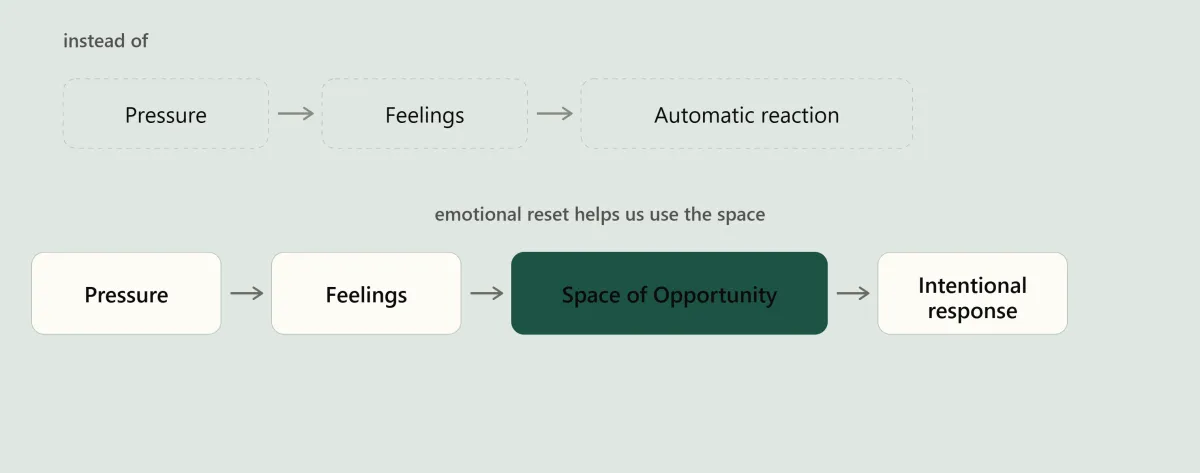
That space matters because it gives intention an opportunity to influence behavior before an automatic reaction takes over. This does not mean eliminating emotions. It means developing the ability to remain connected to how you want to respond even when the emotion is real and intense.
Why this matters beyond the meeting room
The way we respond under pressure affects more than a single meeting. It shapes trust, communication, relationships, and how we leave important moments feeling about ourselves.
Someone may deliver an excellent presentation and still replay the one defensive exchange that followed. Another person may make the right business decision but regret how they spoke to the people involved. In both cases, the outcome is not only external. There is also the internal question: "Did I respond the way I intended?"
Executive presence becomes more meaningful when it is not simply about appearing composed, but about responding in a way that remains aligned with your intention when the moment becomes difficult.
Reflection
What does your presence look like in the moment right after the pressure rises not before it?
The Emotional Reset perspective

Executive presence is not only about how you enter a room, communicate an idea, or project confidence.
It is also reflected in what happens when the conversation becomes difficult, emotions intensify, and an automatic learned reaction begins to surface.
Emotional Reset addresses the gap between intention and reaction by creating the space where a different choice becomes possible. When your response reflects how you intended to show up, presence becomes more than an impression. It becomes alignment.
Frequently asked questions
What is executive presence coaching?
Executive presence coaching often focuses on communication, confidence, credibility, and how a professional is experienced by others.
Can someone have strong executive presence and still react emotionally?
Yes. Professional capability and emotional reactions are not opposites. Learned reactions can surface even in highly capable people when emotions intensify.
Why do I react differently under pressure than I intended?
Pressure can intensify emotions and bring automatic learned reactions to the surface before conscious intention has an opportunity to guide the response.
How is Emotional Reset different from executive presence coaching?
Executive presence coaching often focuses on how you present and communicate. Emotional Reset focuses on creating space between feeling and reaction so your response can better reflect your intention.


Ready to Respond Under Pressure the Way You Actually Intend To?
Emotional Reset coaching helps you build the space between emotion and reaction so executive presence, nervous system regulation, and decision making under pressure finally align with how you actually want to respond. Ready to stop reacting and start responding with intention?
related articles
How to Improve Decision Making Under Pressure
Everyone has experienced the moment. A difficult conversation begins. An unexpected email arrives. A client
Nona Giddens
Nona Giddens
How to Stop Reacting Impulsively Under
Most people don't intend to react impulsively. They plan to stay calm, listen well, and handle difficult conversations..
Nona Giddens
Nona Giddens
Why nervous system regulation alone doesn't
You recognize the tightness in your chest. You notice your breathing change. You know your body is responding to to
Nona Giddens
Nona Giddens
© 2026 Alessandra Group - LLC emotionalresetgroup.com